Ads – Pay-Per-Click

Two Things You Can’t Ignore: Landing Pages and Quality Score

I am quite certain some of our clients, and others who take advantage of advertising using Google Ads, wonder why we frequently talk about landing pages and quality score. Well, they are simply two things you can’t ignore!

The experts at Google and elsewhere write about understanding the landing page experience, and it is important to know what they say about it. It is also important for anyone wanting to maximize their investment in Google Ads to use the advice they offer.

It today’s AI search world, landing page success relies heavily on message match. If a user searches for “same-day emergency dental implants,” your ad should say it, and your landing page headline must immediately echo it. When a page immediately validates the user’s intent above the fold, bounce rates plummet, and trust goes up.

How Landing Pages Dictate Quality Score

Your landing page accounts for a massive portion of your Quality Score evaluation. Google judges your Landing Page Experience based on concrete technical and behavioral indicators:

  • Mobile-First Design & Speed: Google places severe weight on mobile responsiveness and page load times. A single-second delay in mobile load time can drop conversions by up to 20%. If your page is slow, your landing page experience rating drops to “Below Average,” tanking your overall score.
  • Transparency and Trust: The page must clearly feature privacy policies, clear pricing/terms, contact information, and security signals (like reviews or certifications).
  • User Engagement: If users consistently click your ad and instantly hit the “Back” button to return to the search results page (known as pogo-sticking), Google notes that your page failed to answer their query.

What is Quality Score and Why it Matters: 

Quality Score (QS) is a 1-to-10 diagnostic rating Google assigns to your keywords. It measures how relevant and helpful your ad and landing page are to someone performing a search. It is determined by three core components:

  • Expected Click-Through Rate (CTR): The likelihood that users will click your ad.
  • Ad Relevance: How closely your ad text matches the intent behind a user’s search query.
  • Landing Page Experience: The value, speed, and clarity your website provides once they click.

The Financial impact: The “Quality Score Discount” 

Quality Score directly dictates your Ad Rank and your Cost Per Click (CPC). Google penalizes low-quality experiences and rewards highly relevant ones. If you have a poor Quality Score, you pay a steep penalty (Google calls it a Premium)  for traffic; if it’s high, you get a massive discount.

  • Rank: 10/10 ~50% Discount
  • Rank: 5/10 Baseline (No discount / no penalty)
  • Rank 1/10 400% Penalty

A low “Quality Score” forces you to over-bid just to maintain visibility, effectively bleeding your ad budget dry.

To succeed in today’s rapidly changing search world,  you can’t treat your landing pages as an afterthought to your keyword strategy.

Here is more from Google on Quality Score.

Don’t forget. When it comes to Google Ads campaigns,  there are “Two Things You Can’t Ignore: Landing Pages and Quality Score.”

P.S. Creating every page on your website with landing page experience in mind will serve you well in organic searches as well.

PPC – Why You Should Bid On Your Business Name

Google AdWords Example AdThere are many excellent reasons to invest in a Google Ads, Bing Ads, Facebook and other PPC (Pay-Per-Click) campaigns. If you have read this blog or talked with us, you know we believe nearly every business should be taking advantage of PPC advertising. If you do nothing else, start a Google Ads campaign and bid on your business name.

Here are a few good reasons why you should bid on your business name.

  1. Branding - Improve Brand awareness - Value without paying for clicks
  2. Double Exposure - Display in PPC Ad and Organic listings
  3. Improve your CTR using Google AdWords "Extensions"
  4. You control your ad content
  5. Often, competitors are bidding on your name
  6. Make it easier for returning customers and other visitors to get to you

Start doing cost effective branding today by bidding on your business name.

Call us about starting a Google AdWords campaign. 1-800-281-9993 or 608-822-3750 

Two quick ways to jump-start your new website in Google SERPS

1. Use Google Ads

We always suggest to our new clients that they use Google Ads to jump-start the new web presence. (It is also a good marketing tool for a redesigned website or doing a new product launch, among other things.)

An inexpensive Google Ads campaign gets your name, along with a description you control, at or near the top of search results pages and can keep it there while your individual pages get indexed and, if they are created properly with good content, starting earning their way up the organic listing rankings in Google.

2. Use X (Formerly Twitter)

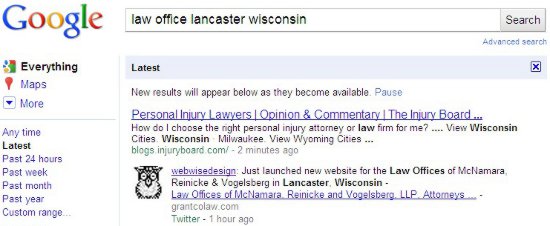
We announce all new websites we launch for our clients. Those “posts” show up in Google very quickly. In fact, it happens sometimes in seconds and always in a very few minutes. The URL in that tweet gets indexed as well. There is no waiting for Google to “discover” your website from a link on another website or from your sitemap.xml (ask your webmaster if you have a sitemap.xml). In the example, I did the search about 70 minutes after using Twitter to announce the launch.

Google SERP of Tweet

Even though we tweet about our client websites, we highly recommend that they, and others, use X to get news of their website, not only to those in the Twitter universe, but to Google as well. It only takes a quick tweet and delivers a lot of benefit.

Summary: Google Ads and X (Formerly Twitter), Two quick ways to jump-start your new website in Google search engine results pages.

Keyword Research = Higher Google Search Results Rankings

It is no great revelation that keywords are essential in getting your website to rank higher in Google search results. That said, too often not enough attention is paid to keyword research. Knowing the queries people actually use, is integral in getting the visitors you want to your website

Google Search box

Now, the folks at Google are going to tell you to just write good copy that your potential visitors find compelling, and your rankings will take care of themselves. While that is true in a perfect world, it isn’t quite that simple.

Of course there are may factors (Google’s Matt Cutts says 200+ “signals”) that dictate where your listing shows up on Google’s search results pages, and the keywords on your web pages are only part of it. The fact is, they play a very big role.

Why is keyword research important? Well, your visitors won’t get to your website so they can read your “compelling copy” unless it contains the keywords your potential visitors use when they do a search on Google, or other search engine. Your web pages may have “compelling copy” as far as you are concerned, but are you thinking about the same keywords as your potential visitors? Keyword research can help you figure that out.

Where to start? Write your compelling copy, and then read it out loud. How does it sound? Did you or your audience hear keywords you believe potential visitors would use to find your products or services?

Make a list of keywords you believe identify your products or services. Ask for input from co-workers, customers, friends, your barber, or hair dresser.

Take a good look at the list. Are all or some of those keywords on your website? Remember, Google sells relevance. Your pages should be product or service-specific, as should your keywords. The wrong keywords may get visitors to your website, but those visitors may not stay, because they were looking for something you don’t offer. Your goal should be to attract self-qualified visitors (leads, prospects) that want or need what you offer.

Okay, let’s see if anyone actually searches for your keywords. Google has a good free tool (Google Keyword Tool) for you to use. It is geared toward those who are using, or may use, Google AdWords. You do not have to have an AdWords account to use the keyword tool. It will show how much competition there is for your keywords, global monthly searches, local monthly searches, and more. You may do a simple search, or they’ll give you more options than you will care to deal with. Keep it simple. You just want to see if people really are searching using your keywords.

If your keywords have a lot of search volume, you should use Google Trends, where you can search for two terms, e.g. lake property, lakefront property, and you’ll see charts showing the relative search volume (more people search for lake property). You can filter the results by date, regions, cities, etc.

There are non-Google tools out there as well. A very good one is the Free Keyword Suggestion Tool From Wordtracker. Another is WordStream’s Free Keyword Tool.

There is a great deal more to say about keywords, and we’ll discuss them again. Hopefully, this will give you an understanding of the importance of choosing the right keywords. One of America’s favorite authors knew something about choosing the right words when he said, “The difference between the right word and the almost right word is the difference between lightning and a lightning bug.” Oh, that author if you are wondering, was Mark Twain.

Go to work and make that keyword list today! Edit that compelling copy to contain your researched keywords, and get results!

Keywords, Ad Copy, Landing Pages – Triumvirate

Talking about Pay-Per-Click, Google Ads mostly, search results and landing pages is pretty much a daily thing around our office. Accordingly, it makes sense to talk about it here.

Years ago I had the opportunity, thanks to Andy Lewis, to be a part of a Webinar for "The National e-Commerce Extension Initiative" named "Maximizing Your Pay-Per-Click Campaign."  We concentrated on Google Ads when it was still known as AdWords. Why? It is my humble opinion that for most, a limited advertising budget is a reality. Google is the 500-pound Gorilla, and if you are going to feed web advertising money to anyone, it should be Google with over 72% of U.S. searches reported for February, 2009 according to Hitwise.

Last week I met with several representatives of one our largest clients, and discussed mostly Ads and Analytics for the better part of the afternoon. In both cases we talked about Keywords, Ad Copy, Landing Pages at length. Why? Having high placements in Google Ads or Google organic search results is directly related to those three powerful terms. They rule this world as surely as many of the Triumvirates of history.

The importance of Keywords, Ad Copy, Landing Pages, is a simple concept, while not difficult, that is complex in implementation when done correctly. The good news is, you don't have to spend in inordinate amount of time working on your Ads campaigns to get some immediate results. Very simply, just make sure your keywords are in your ad copy and on your landing pages (prominently). If you do that, you will see your Click-Through-Rate, aka CTR, improve as well as your placement.

If you, or your search professional, spend the time on your landing pages to write keyword-relevant "Titles," meta "Descriptions," Headings, and content including the keywords that potential visitors would using when searching for your product, service, or information, and you write quality ads, as well as conducting ad-variant testing, you will be rewarded with increased, targeted, self-qualified traffic. Serious keyword research, a knowledge of how Google likes your pages coded, and knowing how to write and place that code is part of what will take your Ads campaign to another level. Of course a thorough knowledge of Ads and your analytics program is necessary as well if you want optimum results. To that end, unless you have a lot of spare time, working with a search professional who has experience and successes on their resume is essential.

One of the cool benefits, is that, the time you, or your search professional, spend on your "landing pages" will eventually manifest itself as higher rankings in Google's search result pages, aka SERPs. Google sells relevance. Make sure your site search strategy, both PPC and organic, includes relevant keywords, ad copy, and landing pages.

By the way, WebWise would like to be Your search professional! Contact us today!

Keywords, Ad Copy, Landing Pages - The Triumvirate!